Showing posts with label landscape painting. Show all posts

Thursday, February 11, 2021

The Battle of Coon Creek Historical Marker, Kansas, U.S. Highway 50

The Battle of Coon Creek Historical Marker, Kansas, U.S. Highway 50
acrylic on five shaped ragboard panels, artist-made frames
6 x 48 7/8 x 1 3/4 inches


The historical marker for The Battle of Coon Creek is located two miles east of Kinsley, Kansas, on U.S. Highway 50. Although the sign failed to position the conflict, I am fairly certain that it didn’t happen right by the highway. The Arkansas River crossing comes up before that of Coon Creek, on the way in to town. It may have made more sense, to place the historical marker somewhere along the creek. Although where it is might be closer to the actual site, it’s not that easy to envision the battle terrain, surrounded by mounds of prairie covered sand dunes. I liked the historical maker; it was a designated place to pull over. That fondness extends to any set of trashcans cans, with or without the presence of picnic tables. The opportunity to stop and inhale a spot along the highway is a significant part of traveling. Without it, a journey can be reduced to mileage, a meaningless quest for destiny, where time steals from the spectacle of oncoming horizons.  


The battle involving U.S. troops and Plains Indians occurred in 1848. I’ve decided to skip most of the posted information. In two trips across Kansas, separated by a year and a half, a new sign replaced the old with a different history. That discrepancy could be due to what to cover in the limited space of couple of paragraphs. However, what each sign had in common was the description of an Indian woman clothed in silver ornaments and a scarlet dress, supervising the removal of the wounded while riding around on horseback. Based on the difference between signs, a motorist restricted to seeing just one of them, would come away with a less complicated view of the solidity of history, written about events grounded in the shifting sands of Kansas.


The intriguing thing about photographing a site is that I usually know how much to include. However, once a scene is moved to my computer, I no longer recall exactly what I saw, until the information is laid out for painting. When I saw the pencil rendering extend across the panels, I was delighted and surprised by the latitude of the tree’s shadow. Although I keenly remember seeing the shadow, I was unaware of how much it would influence the mood of the painting.


Painting a designated place to pull over is not a new arena for me. I’m smitten by any landscaping that leans into the immediacy of scenery. I find such a site a difficult invitation to skip. Although my father was not in my thoughts when I stopped to look around, when the painting begin to materialize, something about the broad shadow and the vista beyond, reminded me of traveling with him. I’ve consumed a lot of time wondering why that should be. Traversing the plains of Kansas was not an experience I had with my dad. Everything about life included something to do with mountains. When you’re raised in Utah and Nevada, there is no place to go, where you can outpace the face of geology. Anywhere out on the highway, slumbering mountains arise all the way to the coast of California. The only thing that this painting shares with the memories of traveling with my dad is the presence of a trashcan. It’s hard to believe that such a minor detail could be so meaningful. But as he drove, he seemed to fill ordinary mileage in with a sense of adventure. The highway wasn’t just about getting to an astonishing site, it also included a veneration for all the places in between.


I never uncovered a specific reason why this painting reminded me of traveling with my father. Perhaps, it just comes down to where I happen to be. He has been dead ten years now, and so it may be easier to fully appreciate the vision his living gave to me. With his dedication to the highway, it is not surprising that I grew to love the swell of every oncoming horizon. The clout of topography can be measured by the fact that it precedes the parameters of meaning. It is there. It is out there. And as such a place, narrative has no sway within the realm of surroundings. That’s the thing I admire about landscape painting. It is an open ended enterprise, mysterious enough to be the original Rothko. Because earth and sky defy description, painting never reveals anything about me, leaving the terrain vacant for anyone wishing to engage in a narrative free mystery.


Thursday, October 1, 2020

Highway Altarpiece: “The Child Is Father of the Man”; from Kingston, Ontario, Canada to Holden, Utah; U.S. Highway 50


Highway Altarpiece: "The Child Is Father of the Man"; from Kingston, Ontario, Canada
to Holden, Utah; U.S. Highway 50
acrylic on a shaped ragboard and paper construction, artist-made frame
8 7/8 x 23 13/16 x 3 7/8 inches including frame


It is hard to know what kinds of things I would have painted as a child. However, I believe that the primacy of sight ultimately determined the path I would follow. Although the journey was anything but straight, I came to believe that at any given moment the world is already composed. In thinking of life, a line from William Wordsworth’s poem, “The Rainbow” comes to mind, “The Child is father of the Man.”


Because I am primarily a visual person, memory takes me back to a time that could precede speech. I remember the neon sputter of a sign in the night when I was two. To the surprise of my mother, I could describe our apartment over the drugstore years later. I remember my baby sister Kim coming home from the hospital when I was not quite three. I remember snowflakes that I caught in a pot, and the pleasure of digging in the dirt come summertime. A highway drive, gloomy skies, and an A & W Root Beer sign occupy early childhood memories. There was the body of a great lake long before I knew the name Ontario. I remember grandparents, the scent of tobacco, and the sound of small boats on the bay. Even now, the faint sound of a lawnmower recalls a Canadian infancy.


Painting became a conscious thought when I was five. I was with my father. We stopped to look at a yard sale of landscape paintings. That’s when I realized that seeing was something that could physically be described. But because what I saw was a small sampling of what a landscape could be, without knowing it, my vision ended up being restricted. The possibility of painting routine scenes from Division Street receded with seeing paintings devoted to the depiction of pristine nature. That is the problem with art. It is difficult to conceptualize painting without first seeing a canvas covered in paint. But once you know what painting is presumed to be, that information has a habit of shutting down the thought process. Knowledge can mean freedom, but it can also be a trap. Once a narrative is set, it can be extremely difficult to see beyond the plot.


I outgrew my Green Card long ago. If I’d had the skills of a portrait painter, I would have made a large painting based on its tattered history. However, because my knowhow was driven by the lift of earth and sky, my desire to embrace the challenge of a self-portrait remained just a fantasy. Something began to shift for me, when my brother Steve shot an image of me standing by a highway sign outside of Holden, Utah. The photograph became part of a beautiful catalog designed and compiled by Cheryl Vogel, entitled Lloyd Brown: Framing America


The bookend nature of the painting appealed to me. The two views, with a gaze back to an age when I’d already decided to become an artist, through to a time when I’d lived much of that life made the depiction less about me individually, and more about what it means to grow up seeing. Even though painting people was completely out of my domain, the double self-portrait was something I wanted to confront. In my mind’s eye, I immediately saw the shape and structure. Although, it didn’t include the rendition of a faded paper cup, a vision of a highly polished column roughly the same shape stood in its place. It is only natural that an abandoned paper cup should fill that position, a division in time separating man and child. While it might be a great framing device, the separation created by the discarded cup could also be continuum. When it comes to the joy of seeing, the things that please me now are the same things that thrilled me as a child. However, I didn’t draw or paint most of those things, because as I explained earlier, they didn’t fall within the canon of what was worthy of art. Landscaping painting was a specific kind of seeing. It didn’t include most of what the outside had to offer. I had to enjoy the rocks, the weeds, and the weathered remains of tossed off packaging by myself. But, the secret thrill of seeing beauty in the insignificant bits of travel made walking to school an extremely fun thing to do.


While it’s not difficult to abhor litter, and admit that the planet would be better off without it, I can’t help but see a kind of history behind each piece of degraded paper, broken glass, or tossed off plastic. They are manifestations of life choices, triumphs and decay scattered within the bunching of ever present weeds. Even under the pressure of a highly offensive wind, a rolling paper cup can become blocked by a thicket of tall grass, or become encrusted in a substance no longer bearing any resemblance to mud weathering away into a mystery cup, where a fast food logo, completely undone by the sun sustains a dying refrain, “OF THE GREAT AMERICAN BURGER.”


As a two year old, life remained largely undefined. Without the framework of gender, race, church or state, there was no separation between me and being. Meaning was a thing unto itself. It didn’t require God or belonging to see wonder and significance. Perhaps, remembering those early impressions led me to object to the compositional take, which eliminated so much of what I saw everyday on my way to college. However, the need for that procedure didn’t seem to bother anyone else.


It took me years to fully understand what the compositional problem was. The paintings we base our concepts on didn’t come from observations of the countryside. In the beginning, it was Biblical and mythical figures that took the stage. Events from literature are happenings that we can’t witness. Story sourced paintings can’t emerge without an arrangement of models and props, or without relying entirely on imagination. Either way, composition comes into play. Paint that way long enough, and the methods become rules, which begin to shape the way we see everything around us. They can even persuade us to rearrange items placed on a table, so that a salt shaker or glass can have the prominence that a Greek goddess would hold. The layout of everyday living stops being a thing we want to see. The notion of having a dominant object applied to observations of a countryside seems like a very curious thought. Why should the act of positioning, a consideration equivalent to the placement of king or prophet be a thing needed to capture the abundance of pasture? The need for focal points seems to defeat the freedom that the open spaces are supposed to offer.


Although I’ve painted landscapes without the aid of staging for more than three decades, I’m not entirely at odds with those that choose to use composition. Because the domain of observation always exceeds me, I don’t apply the needs of hierarchy to a horizon that will continue on long after I’m gone. However, since not everything I paint is a situation or place that can be observed, I must also sometimes rely on composition. This piece is a good example of that. It is impossible for me to see separate events in my life side by side. The visualization of that requires some kind of staging. While “The Child is father of the Man,” the adult rendering of me comes first in this painting, because we cannot see the future. We can dream, which I did as a child; but we can only evaluate the impact of our imaginings by looking back in time. The landscape paintings I grew into come from who I was as a child. What I could not have known, when I saw those paintings at the age of five was how long it would take to get to a place, where landscape painting could embrace the wonder I beheld in the very beginning. When I’m on the highway, the connections can be so strong, that the outlines of humanity simply begin to slip away. When you begin to feel a part of everything you see, what could be more sacred than the refrain of an open highway?


The Rainbow


My heart leaps up when I behold

   A rainbow in the sky:

So was it when my life began;

So is it now I am a man;

So be it when I shall grow old,

   Or let me die!

The Child is father of the Man;

And I could wish my days to be

Bound each to each by natural piety.


William Wordsworth 1807


Friday, March 15, 2019

Downtown by the Courthouse, Union, Missouri, US Highway 50

Downtown by the Courthouse, Union, Missouri, US Highway 50, 2019
acrylic on four shaped ragboard panels, artist-made frames, 6 9/16 x 42 1/8 x 1 15/16 inches


In the fall of 2014, I hit the road to cross the continent on U.S. Highway 50. Beginning in Ocean City, Maryland, I headed west in the direction of California. Traversing the midsection of America, embraced the states of Maryland, the District of Columbia, Virginia, West Virginia, Ohio, Indiana, Illinois, Missouri, Kansas, Colorado, Utah, Nevada and California. I intended to photograph the towns and cities along the way. In addition to the towns and cities, the plan was to capture the topography of natural places, the rivers, plains, mountain ranges, deserts, scrublands and forests that occupy the continental expanse between the waves of opposing oceans. The direction of my journey mirrored the growth and expansion of the United States. Although I never gave it that much thought, the age of many of communities reflected that history. I just wanted to chronicle the American scene from the vantage point of a single highway.


Not long into the trip, I began to understand that I wouldn’t be able to account for every single town along the way. Some communities didn’t exist on the map, while others were simply missed because I failed to see that I’d driven through them. Sometimes I turned around to correct the mistake, and sometimes I didn’t. Without the abstraction of a map, it is hard to determine what is or is not a town.


I never fully expected to document everything along the way. A full accounting of the towns swallowed by cities would have required getting on and off freeways trying to find the heart of particular places in the middle of smog infested sprawl. That level of commitment would have added a lot of time to the trip, consuming funds that I couldn’t afford to spend. Wandering through congested intersections trying to find community cores long lost to the circumference of cities, probably would have destroyed the feeling of freedom that comes from chasing down a horizon. Union, Missouri was the first town far enough removed from the stuff of St. Louis for me to want to resume photographing the trip. On another day, mood and atmosphere may have changed everything. As I recall, I was quite a way out before I recovered the mood of solitude attuned to the rhythm of the highway.


As I considered my journey, I noticed that I shot very few places as a single photograph. That should not be surprising. I long ago disregarded the concept of the composed. It seldom got at the nature of place. Photographing immense concrete canisters half cast in shadow can capture a stunning array of shades in rolling forms of architecture, but it doesn’t say anything about the surrounding town, or how those lofty grain elevators relate to the rumble of moving freight trains. The proportions that shaped rectangular framing when artists routinely painted portraits of aristocratic families are poorly matched to the task of embracing the geography of travel. What oncoming town can properly be defined without the horizon? How do you fit the tree lined streets that profile an interlocking sky of protruding rooftops, power-lines, steeples, and the metallic gleam of a solitary water tower into a space designed to house a family portrait?

The history of Western art didn’t have much of anything to say about the landscape in the beginning. Painting was primarily used to depict mythology, Biblical scenes, and aristocracy. The landscape was rarely subject matter in and of itself. When it did appear, it was usually part of a larger story, like the Holy Family’s flight into Egypt. Since Biblical and mythological events could not be observed, the participants and scenery had to be imagined. Models standing in for gods and heroic figures created staging. Within that space, it was natural enough to make the leading man or woman the center of attention. By trying to drive the viewer’s gaze to the main character through devices such as perspective and lighting, a focal point was born and composition became an important part of making art.


As my mind rummages through images from art history, what I discover are configurations of leading figures and secondary cast members. Composition was designed with people in mind. Hierarchy, the concept of thinking that some people are more important than others became a way of portraying everything around us. Flowers arrangements involving bottles, pots and saucers, shouldn’t have a need for one of the containers to stand out on the table. Dominance in a painting of fresh cut flowers has nothing to do with seeing. Being human, our egocentric thoughts consume our perspective. It doesn’t matter where we’re looking, the rules remain the same. We treat scenery as though it had human consciousness. Barn, horse and tree are crammed into a compositional huddle that resembles yet another family snapshot. A concrete silo is framed as though it would know how to pose for a portrait. What gets lost in painting a mountain range is that its granite mass sat upon the plain long before portraits were ever conceived of Jesus or a king. Earth and sky and everything in between should not be confined to the interior dimensions that were historically used for painting people. The great outdoors is defined by atmospheric space, where distance is the measurement of shades shifting to the lackluster blue of a warped horizon. For those attuned to the highway, the profile of sites resides within an overwhelming sense of atmosphere. What I am trying to say is that the subject matter of any vista is always space. The thing that makes a landscape real is the absence of a stage. The sky overrides the notion of any man-made thing being equivalent to a king. You may be thrilled by highlights on a silo, but the thing that dominants all other things is an atmospheric weight that can’t be defined by a pose or profile. How can you encompass the brilliance of sunlight or shepherd the will of the wind? Human thoughts of dominance have very little to do with the buoyancy of a blue horizon. The embrace of landscape is the manifestation of space.


In my time at college, there was never any history given for the origins of composition. No one tried to explain why a focal point should apply to rudiments of a horizon. It was simply understood that painting required designing. Straight up observation was never enough. The experience of everyday seeing couldn’t be conveyed through painting. The sight of turned up earth and silo was not enough to make a painting great. That kind of experience couldn’t be understood as being any good without the concept of dominance being brought into the picture. If you think scenery needs to be tweaked or rearranged for it to be compelling, I hesitate to say that’s entirely wrong. I’ve never been interested in depicting people or painting items placed on a table. The life I enjoy has been about the highway. The trill of weekend drives inspired me to take up painting when I was a child. My perspective comes from a need to embrace the depth of perception seen while gazing out at a horizon. That need could be just as flawed as the compositional thinking that I believe to be so misleading. My view could be derived from shyness. I don’t like crowds. I seem to need a lot of space to feel at ease. Because of that fact, I may not be drawn to patterns that mirror the structure of social events. Still, my human intuition is probably closer to the makeup of nature because it doesn’t require the artist to decide what part of the scenery is supremely meaningful. What I see is exactly as it should be. I can’t imagine making any of it better. In that respect, I could be religious. I feel much smaller than the things I try to describe. Sky as sky cannot be shaped into anything greater by adulations of paint.


I’ve taken enough photographs to know, that two consecutive shots of any place provide enough perspective to establish a sense of direction. Within that framing, you’ll probably find something that resembles a composition. That amount of space embraces something that could be called delineation. Just like when trying to draw attention to the countenance of a king, there is a pull which does the same kind of thing. The expanse of consecutive snapshots is filled with a perspective that can’t be denied, drawing the viewer into the scenery. The difference being that the viewer gets to choose what destination he or she is drawn to. Painting is based on observation. The choice to delineate or compose is a matter of perspective. A composition tries to make it plain, that a specific person or thing is the most crucial part of a painting. Delineation doesn’t comprehend individual significance. Because it knows everything is connected, its devotion of focus extends everywhere. In composition, the delivery of space happens on a stage. That might be fine for a literary production or family snapshot, but it doesn’t begin to comprehend what it means to be outside. Composition comes with the limitations of a box. It can’t hold very much. That rationing shapes what we select to see. The isolation of prominent sites is forced upon us. Snapshots taken on vacation seldom do the trick. The singularity of a mountain or tower can’t begin to tap into the essence of memory, because that isn’t what we see standing where the latitude of sight bleeds into breadth of yawning atmosphere. Compositional framing can’t fully embrace the meaning of place, because it tries to apply the standards of indoor habitat to an environment truly beyond those dimensions.


If two snapshots are enough to establish some kind of connection, why do so many of my paintings rely on a span of three or more photographs? I hadn’t thought about it before. But on this trip, I began to realize that what I sought for so many years was something greater than the delineation of space. Although the combination of two snapshots is similar to composition, I seem to follow the advancing camera until it has moved through enough frames to engage a visual position. That doesn’t mean that the description of a place should be thought of as fixed or definitive. Within the range of any location, there are limitless stories to tell. When the advancing camera stops, it just means that I think I’ve captured enough to justify suspension. Nothing in that says this is it. There could be more. There could be so much more. It just signifies that I hit the first frame that secures the character of place.


In embracing the landscape, I ended up chasing something that could be called narrative. My childhood imagination always recited a dialog of sites on the way to any horizon. That innate nature survived to thrive into adulthood. I see a parking lot with its shops and laundry mat as a place of exploration. Having that kind of reaction, every site can’t help but feel like it should be a feature piece dedicated to the thrill of living. Perhaps what I do could be described as a kind of journalism. There is a story to tell, but the facts matter. A couple of snapshots may pinpoint a place, but the word on the street calls for a broader perspective.


The two center panels depict the courthouse. Any two consecutive images taken
with a camera, will feel quite a bit like a composition. 

In my painting of Union, Missouri, the two center panels depict the courthouse. The view in and of itself could be complete. There is enough perspective to determine that the courthouse is part of a location. Without that added space, the building would be just another architectural headshot, a postcard kind of thing without the heft of gravity pulling everything together. Composition seldom has enough perspective to convey navigation and place. If those components are missing, it is difficult to see the terrain that makes up mountain, town or valley. And without terrain, can a landscape painting really be aligned with the land it was intended to describe?


Standing near the Oak intersection of Locust Street, I shot beyond the courthouse. That extension enables the viewer to be like a pedestrian. If you can visually move around, frozen moments begin to melt away into a tale of exploration. Exploration requires time, and with that time, painting can become a living thing. It can describe blue sky, ornamental trees, a courthouse surrounded by street lamp banners, a neon sign, fluorescent lights, a shadowed wall, a window encased display of a wedding dress, and the indication of fall where changing leaves succumb to the grip of October. Seeing is the story of being there. It’s often been said, that a picture paints a thousand words. If that’s true, and I believe it is, most of the words are going to be nouns and adjectives. Although painting can’t explain, it’s great at illustration.


I hesitate to say that my painting could be narrative. Because the idea behind narrative painting troubles me, I’ve got some explaining to do. The category as defined is deceptive. It leads people to think that a certain kind of painting has the capacity to explain the action of unknown events. That’s what storytelling does and stories can’t be told without language. Perhaps, narrative painting should be defined as the depiction of an incident so widely known that it wouldn’t need a picture to visualize it. A canvas of the Last Supper may make a great painting, but it doesn’t reveal anything that wasn’t already known. The story it tells was already in the head of the person seeing it. I know I’m stating the obvious, but the statement should make it plain that all painting is the same. It can depict, but it can’t carry on a conversation. A painting of an apple can say apple, because the viewer already knows what an apple is. Without prior knowledge, the Last Supper is just a painting of a dinner party. No amount of paint could ever betray the middle figure as Jesus. Just like with the example of the apple, the information was already known.


Now that the Last Supper has been exposed as being basically the same as the Apple, we can go on to say that although painting can’t do storytelling, it has the capacity to recite the details of sight, which words simply cannot handle. When writing about sky, the concept is so ethereal that the only the word that can really describe sky is sky. As an atmospheric noun, there are never enough adjectives to color in transitions of blue. The nouns and adjectives of routine seeing are so numerous that if they were all written down to describe a place, the ability to envision it would be consumed by chaos. Language simply cannot deliver all the details my painting provides and remain unbroken. Any attempt would require inventory lists, itemizing details and relationships which could never be arranged in a sequence that could be read from any starting point, in any direction, and be completely understood in an instant. That is the domain of paint. When depicted as imagery, nouns and adjectives are not restricted by the linear constraints of language.


Painting can easily relay the information of sight. In that respect, it exceeds language. But it can’t examine love, fashion a plot, or casually say, I think it’s going to rain tomorrow. So in what respect could my painting offer more than a description? A lot of it has to do with the span of perspective. By going beyond parameters of composition, the viewer gets to choose how to investigate the setting. With that choice, the viewer stops being a bystander. Because Union, Missouri is presented in rolling sequence, the navigation of place happens naturally. In the concrete details of the tree lined streets, there is a spirit of recognition. It is an inventory list of routine details, which in many cases the viewer didn’t realize had any clout. Responding to frozen moments inhibits reaction time long enough to see beyond banality. It may be a scene that the viewer wouldn’t normally like, but being anywhere comes with a collection of memories. In the depiction of a particular place, it is the act of navigation that grabs the imagination. When vision is painted as the tool that it really is, it can’t help but fuel connections. Getting anywhere is dependent upon information that painting frequently excludes. By profiling sight over the composed focus of isolation, scenery begins to tell a story. I have no idea what the story will convey. But within the rudiments of a small town intersection, there are impressions that ignite the recognition of having seen this kind of place before. Because I’ve done nothing to influence your perspective, the connections you see will be entirely your own. In my imagination, as far back as I can remember, I was a travel guide and explorer. When I realized that nearly everything I saw went well beyond the window of composition, I changed the way I painted. Openness without focus was so much closer to the navigation of getting around, that many could feel a connection to forlorn parking lots. As a kind of travel guide, I see no distinction between barnyards and national parks. I paint moments that everyone knows. By painting the routine passage of time, I capture the beauty of what it means to see. Living can be hectic. Seeing another bleached out street can feel mundane. Attending church next to an ailing shopping center probably doesn’t do much to inspire, but what does that have to do with vision? You’re alive! The sky is still the sky. Seeing is such a gift that I can’t begin to comprehend banality even in a desolate parking lot. With that enthusiasm, I tap into the bare bones of living. In going for the moment, any moment, there is a commonality we share, and it is that commonality that reads as narrative.


Friday, April 1, 2016

Painting never is an Imitation of Nature

Uptown Splash, Dallas, Texas
acrylic, charcoal, paper, canvas, and wood
12 1/8 x 90 11/16 x 1 5/8 inches

Although, I’ve spent nearly 30 years dedicated to landscape painting and the idea of time and place, none of that would have been possible without my background in abstraction. The two are often thought of as completely separate ways of being. That has never been my experience. Painted observation is frequently seen as the imitation of nature. The problem with that idea is that there are no ready-made colors or brushstroke that symbolize earth and sky. A tree painted of lines, dots and scribbles is not a copy, any resemblance to a swaying pine is in every sense an invention.


Dallas, Texas Construction Site
acrylic, charcoal, water soluble crayon, wood, cardboard, and canvas
7 15/16 x 35 1/2 x 1 11/16 inches


Recently, I’ve made a few pieces that include both ends of the spectrum. In each case, abstraction was my starting point. As I considered the abstractions, they seemed to suggest things like slush and snow, or the subtle colors of an early Kansas spring. These combinations are not intended be a direction, but when they arise, I will let them happen. Over the years, I’ve done many things. I’ve painted leaves, vacant lots, cattle, mountaintops, and residential neighborhoods. There is no escaping nature. It can be found in the sights and sounds all around us. Walking always enabled me to tap into a place where the Grand Canyon and a trashcan are equal. I came to see that the moment was the thing that mattered. In it, all I could see was the lay of the land. From gravel to sky, came the understanding that the topography of paint, no matter how real, can never ever be anything but abstraction.

Battle of Coon Creek, Kansas Sampler, US Highway 50
acrylic, canvas, graphite, paper, and wood
34 15/16 x 7 5/16 x 1 1/2 inches

Saturday, April 5, 2014

Thoughts on Dallas and Landscape Painting: An All Day Excursion of Richardson Heights Shopping Center


End of the Day at the North End of the Richardson Heights Shopping Center...
Left panel detail
mixed media diorama
11 7/8 x 63 3/4 x 3 3/4 inches
1987
 One of the joys of not having to rely on composition is that the entire world is open to you.  The world abounds in the local.  The exhilaration of travel can be had by riding a bike or strolling down an alleyway.  A walk across a parking lot can fill with a sense wonder. The peeling paint of a rusted dumpster may be a bit of a kick, a heart rising skip, the arrested freshness that comes with every new encounter.  With this state of mind, every day, every time of day, every atmospheric condition is splendid.  Life is even bright in stormy weather when design no longer denies a child eye view of everything as treasure.  A vacant lot becomes a place of nature.  Even blacktop and shiny metal cars beam radiantly.  Stepping towards the theatre, life happens in the wind.  Trees and shrubs throw off pollen dust to the flutter and buss of flying insects.  Car doors open and close in moments of lowly grandeur.

End of the Day... full two panel view
 
I once spent an entire day observing the habits of Richardson Heights Shopping Center.  I arrived before dawn, and left just after dusk.  It was Sunday.  There wasn’t much going on.  The Texas Blue Laws were still enforced.  Given the current political conditions of the state, the past could easily seem like a golden age of liberalism.  Anyway, the idea was to do an entire exhibition based on a single day in a parking lot.  I know that’s taking the idea of local to the extreme, but I was confident there was more than enough to see to make for a very exciting show.  Although I didn’t go that route, I easily could have, and some very nice dioramas came from the all-day excursion around the grounds of the shopping center.

The tools of the trade didn’t include pencils, sketch pads, canvas or paint.  The engagement with any particular place is too enjoyable to be distracted by the practice of painting.  I came to see and feel the life of a specific place in my neighborhood.  To help with that endeavor, I had a camera and a notebook.  I brought a folding chair to sit in and a tape recorder to capture sound.  Most of the noise was traffic.  The ebb and flow was the aggravated ease of a lazy summer Sunday.  The recorder also captured a chirping scurry of birds as dawn gave way to shape and shadow.  Early in the morning, a Corvette pulled into the north end of the shopping center.  The car door opened and a policeman stepped out.  Within no time at all, I understood what was happening.  The shopping center filled in with cars.   He was a crossing guard for those going to church.  There is no way to explain this if you have not lived in Dallas.  Although most people don’t seem that pious during the week, when Sunday comes around church overtakes state, and traffic patterns are managed to meet the needs of church going people.  When church was over, the parking lot quickly emptied out.  I wandered around taking pictures.  I noted business names, inspected litter and paid some attention to the activity of ants.  When you have all day, you have all kinds of time for long drawn out yawns and internal bouts of fascination.  Both modes of being seem to be completely compatible.  I noticed meandering cracks.  I stumbled on bits of scattered gravel no longer the embedded compression of blacktop conglomerate.  Faded paint, an exquisitely eroded layer of cap rock divided gray from gray.  The powerful glare of an ever present sun was everywhere.  In pale gray heat, little puffy clouds followed a shadowy path of quiet annihilation.

Around noon, cars crowded in around Wyatt’s cafeteria.  Dining out on Sundays also seemed to be an eventful part of going to church.  Dallas was the churchiest place I’d ever seen, and I grew up in Utah.  Perhaps, when religion is practiced that casually, there isn’t any cost to looking handsome or pretty.  You simply change clothes and persona.  Anyway, the one thing parking lots seem to have in common is an inability to encourage walking.  I once worked a couple of doors down from a fitness center.  Women drove around and around looking for the perfect spot.  God forbid if hips should have to walk.  I wonder if any of them stopped to consider how ridiculous it was to labor that hard to avoid exercise while trying to exercise.  Steps don’t seem to count for much unless they include dues, mirrors, and a cold interior of fitness machines.

Over the years, I’ve heard people say that people are the hardest things to paint.  Naturally as a landscape painter, I don’t much care for the idea.  The statement insinuates that trees are not as hard to paint as faces, and further proclaims that an apple, napkin and hat, and a cold beer stand in lower tiers of difficulty.  I am certain that is not in fact a fact.  Almost any mountain slope is far more varied than any variation in the human face.  The noted difficulty comes from a consciousness that places the human race as the crown of creation.  We spend all our time thinking of ourselves.  Even in societies where a reverence for nature was more prevalent, that reverence was still centered on the inhabitants of man.  With that mindset, nothing else has ever received equal time or consideration.  The standard for mountains has never even matched that of kitchen utensils.  Anyone can paint a mountain.  It’s not hard to see why we would have environmental problems.  We only see ourselves.  As a result, landscape painting has never received true scrutiny.  It is perfectly fine for a mountain to be nothing more than a few gray lines on a horizon.  Very few deeply care about nature.  You can tell that just by the way they drive.  A highway is nothing more than a forgettable stretch between destinations.   Since a person is not a tree, a cloud, or a sage covered bluff, there is no need to heed the particularity of how cloud movements continuously reconfigure cloud formations.  Many painters simply make the stuff up and never really seem notice that the grey underbelly of a cloud isn’t really any darker than the blue sky that surrounds it.  The same kind of laxness won’t fly when considering the profile and tone of a human face.  Try making one up.  You won’t get away with it.  That’s why I have a bit of a problem with the outdoor crowd.  They just paint to feel artistically free.  Painting outside has nothing to do with understanding the subtlety of light.  I think it’s time to put the people thing in perspective.  John Singer Sargent would never have had the success he had if he had plein aired the privileged faces of the Gilded Age.


End of the Day... left panel view
 
As evening began to settle in, my day of observation came to a close.  Although short lived, the pastel atmosphere began to relinquish heat.  After initial cooling, the air seemed to warm up again.  I know that’s probably not the case.  The sensation was most likely tied to increased humidity.  The sun had set.  It was safe for trees to begin to release some of the moisture that had been stored during the heat of the day.  The sound of crickets could not yet compete with cicadas, the noisy creatures of heat that pass the day away in marked intervals of intensity.  Deciduous trees leaned more and more toward evergreen.  Lavender meandered twilight across the sky.  Street lamps intensified the weight of darkness.  Starlight was nothing more than a glimmer of major constellations and possibly a passing satellite.   I snapped a few finals shots as evening settled in.  I loaded my stuff into the truck glad to call it a day, and drove home to my apartment on the other side of Central Expressway.


End of the Day... right panel view

Sunday, January 19, 2014

William Vaughn Howard and a New Framework for Painting


William Vaughn Howard
Title Unknown
acrylic, pastel and graphite
3 5/8 x 22 1/2 inches
The painting above was given to me by my painting professor William Vaughn Howard.  I studied with him as an undergraduate at the University of Nevada, Reno in the early 80’s.  He spent the summers in Greece on the Island of Paros; I bet that is where this was painted.  Although small, it has the structure I want to discuss.   

Detail of the left end
In 1986 I flew back to Reno from Dallas to see what turned out to be Bill’s last show.  What I saw was a group of paintings, the likes of which I had never seen before.  As I recall, 18 inches of verticality rolled out across the walls for another 12 feet.  The 1 to 8 ratio was hard to fathom.  The minor extremity of a 1 to 2 ratio troubled me.  I never knew how to handle the extra space.  The structures were shifting peripheries.  The sweeps eliminated the ability to focus on any particular part of a painting.  Moving through shifting views seemed to be the point of the exercise.  Eyesight could not help but move and vision became a kind of travel.  The absence of a focal point was not a loss.  Instead of leaving, I found myself wanting to resume the sweep of freedom that had carried me away.

Detail of the middle


Although fascinated by the arcs, I couldn’t understand how they came to be.  A rectangle encourages rectangular thinking especially when working abstractly.  When there are no observable curves that you are trying to fit within a space, the action of brushstrokes and splatters happens with an awareness of the outside edge of the stretcher.  It is hard to work a space that is not a conventional rectangle.  When the picture plane is extended, it is visually difficult to stay away from the middle.  This is not a matter of mathematics, but rather one of perception.  Almost any division seems to dangerously align with the middling core of the middle.  The wider the span, the more significant the middle becomes.  Within elongated space, the practicality of a two thirds rule applied to the horizon is exceedingly useless.  How do you compose in any meaningful way covering all that space without becoming lost?

Detail of the right end


When I visited Bill’s studio, he showed me photographs taken in panoramic fashion.  The photographs represented continuous views of coastline running into sea.  I failed to see the significance.  I wondered why align so many photographs together.  I found it a bit confusing.   He died not long after I was back in Dallas.  Within a few months of that visit, I was photographing in the same manner.  Nothing had ever been so exciting.  My neighborhood came alive.  And as I overlapped photographs on the apartment floor, I began to understand the origins of those wonderful waves and how they signaled a need for extremely long paintings.  The arcs are natural to panoramas.  They are the photographic records of a camera turning to embrace the surroundings.  Although, Bill is no longer here to confirm the nature of his compositional structures, it seems plausible that he saw a continuum in photographic prints that were then abstracted onto expansive canvases.

The new views quickly expanded the latitude and capacity of my dioramas.  Once the lay of the land extends beyond the parameters of a single snapshot, landmarks are no longer limited to highway milestones, but include the faded veneers of mom and pop shops along pock ravaged access roads.  There is a realization that composition is comprised of two or more frames of the view finder.  Or put another way, there is no composition to find because the composed is all around.  Point the camera here, there, or anywhere and the added space embraces continuum.  The confines of a standard viewfinder is alien to the everyday navigation of moving around.  Composition is about placement.  Although often thought of as the arrangement of outside objects, there is no need to define or compose when information positions you within your surroundings.  I quickly found this to be true.  When I composed prominent sites, frequently people didn’t know where they were because traditional compositions sever everyday relationships.  When I started painting the insignificant bits of habitation, I wound up painting locations that people instinctively knew much to their surprise.

I believe those last paintings tackled a new kind of vision.  Although the terrain of landscape had been a staple of abstraction, it never contained the breadth of time seen along a highway.  The new was housed within traditional strictures.  Canvasses had the proportions of portrait painting.  Ratios appropriate for the interior life of habitation may not be fitting for the great outdoors.  There was no vista, or distance sprawling out in sunshine, a gleaming rise of stubble gray, pasture, baled developments replacing hay, the magnetic skip of high tensioned power lines, the blue cast slant of earthen furrows, the widespread lisp of horizon outside Deming, New Mexico, the spotted dots of juniper and mesquite tabled between lowly mesas, tin, a windmill that no longer spins, freight on rails, churning smoke, and the elm sheltered trash that marks significant bits of history along an open highway.  The makings of a time horizon that I’ve grown to know as place came into play with the paintings of William Vaughn Howard. 

Information for the images below
City of Richardson from Central Expressway and
Spring Valley Rd. on the Morning of July 4th, 1987
mixed media diorama
8 3/8 x 124 x 3 7/8 inches


Wednesday, January 1, 2014

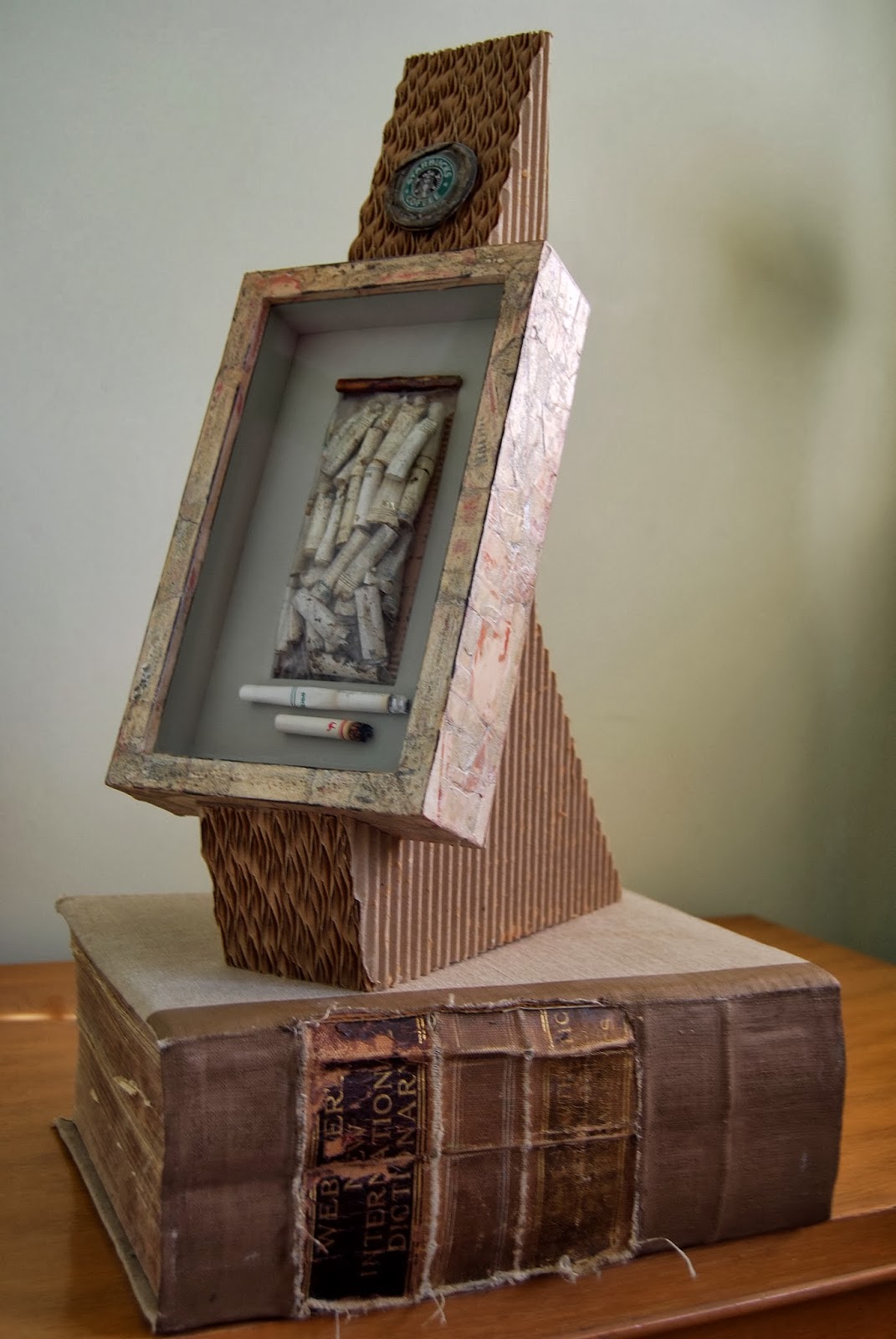
Artifacts Reclamation Project Number 227

Artifacts Reclamation Project Number 227
mixed media construction
21 1/4 x 12 x 9 1/2 inches

For many years, I’ve been a foot-traveler.  The habit had nothing to do with trying to be physically fit.  It was all about seeing, and seeing was so much more than just pedestrian pleasure.  Although often aimless, every footstep maintained a connection to ever changing place.  There was so much to see.  Congregating clouds often housed pools of the deepest of blue.  Breaching the reach of leafless trees, pools of azure shattered into shards, lashing branches whipped a high pitched whistle of the wind.  Transition was a place where texture began to fade away.  I loved the horizon.  When I say horizon, I am not referring to a dividing line, a pictorial joint, a flatland abutment, or a right angled sky welded to the edge of circumference.  When speaking of horizon, it is the fringe of distance I’m talking about.  Recall identifies frail rectangular shapes as motels, hamburger stands and traffic.  Cattle graze within a band of ethereal trees.  Power lines ripple threaded direction to an enclave of indiscriminant buildings on a rise beyond visible highway.  The land of the pedestrian was not only a distillation of blue, but the treading of terrain was a stout round of reality.  It was hard not to see cracked concrete, or a flattened battery corrode in a rainbow puddle of scum.  Civilization comes with hard surfaces.  Sophistication is littered with chunks of consumption that can never be consumed; cigarette butts are fibrous lumps among them.

When I paint, I pay special attention to the close up stuff.  Without that stuff, all you wind up with is a scene, an abstraction, the veracity of dĂ©cor that hangs over a sofa.  Though never a smoker, I’m fascinated by discarded cigarette butts.  Of course, my attention extends beyond their ashen remains.  Broken glass shimmers in flash and shadow.  Empty cans canter a rolling effervescent sound of aluminum castaway.  Scattered bits of gravel blaze a trail of tread and exhaust across chipped and faded paint.  Grass reclaims habitat crack by crack.  Leaves decay on oil stained pavement.  A puddle implies recent rain, front yard drainage, or the cleansing power of a grimy car wash.  Elements coalesce.  The array contains a history of weather and habitation.  Light warms the foreground.  The vista feels ceaselessly fleeting.  Without scrapes of relatedness there is no grounding.  The sky insufficiently blue fills in with petrochemical slogans, a choir of young crystalline unicorns sweetly beam never ending rays of sunlight.   

MATERIAL LIST OF INGREDIENTS: A COLLECTION OF DRIED  CIGARETTE BUTTS, ONE COMMUTER CRUSHED STARBUCKS’S BOTTLE TOP, A PILE OF TORN NAME BRAND CIGARETTE PACKS, AN OIL PAINT MIX OF WAX, ANTI REFECTIVE GLASS, SHELLAC, BASSWOOD PICTURE FRAME MOLDING, RAG BOARD MATS AND SPACERS, SCREWS, A WOODEN DOWEL, SOME HOUSE PAINT SELECTED FROM A COLLECTION OF CANS ON A SHELF, A STACK OF CARDBOARD CUTOUTS WITH THE EXTERIOR SURFACES PEELED AWAY, ELMER’S GLUE, WEBSTER’S NEW INTERNATIONAL DICTIONARY FOUND IN A VACANT HOUSE BY A HOT SPRING ON THE WAY TO TOPAZ MOUNTAIN, A TITLE PAGE PRINTOUT, A SANDWICH BAG, GRAPHITE, A MICA POWDER MIX OF WAX, A NEWSPAPER PAGE BACKDROP, AND THE POST-CONSUMER PACKAGING OF WHAT WAS PROBABLY A CRACKER BOX, ALTHOUGH, AT THIS POINT IT IS VERY HARD TO TELL.

There was an evening when I got very excited about doing something with cigarette butts.  The artifacts of soft cotton littered the outdoors, the playground of childhood.  I saw consumptive beauty early on.  Here I am not referring to the human cost of smoking.  We all have bad habits.  I’m reflecting on the graphic side of nature.  Nature is not only unspoiled places.  It abounds within the sound of urban living.

When I woke, a rare snow coated the streets of Dallas.  Walking to work, I questioned the spectacle of collecting cigarette butts.  I wondered and worried about what others might think of me.  As an artist, I like to think I am free of such preoccupations.  Although, I have never freed myself from the weight of social expectation; I went ahead and tried to ignore the judgment of others.

I didn’t have much luck finding the wet and muddy discards along the streets until I wandered through a drugstore parking lot.  There they were more plentiful especially around some hedges that separated the parking lot from some shops behind a bus stop.  In collecting more and more cigarette butts, I began to feel more at ease in my endeavor.  Then a woman called out to me.  Turning around, I found her standing there handing me a ten dollar bill to buy some smokes of my own.  I explained that I didn’t need her money.  I told her that I was an artist working on a crazy project and thanked her for her generosity.  In watching me, the only thing she could assume was that I was homeless.  Rather than turning away, she offered to help.  Though I was not in need, the gesture filled my soul with joy.  How difficult can it be for us to temporarily alleviate suffering?  Consider what a kind gesture can mean the next time you see someone down and out.  It was nice not to be written off because of my appearance.  I don’t wear a suit and tie.  By simply looking for cigarette butts, I am sure I looked the part.  This kind woman didn’t care how I came to such a desperate situation.  Instead, she chose compassion as a way to begin a day cloaked in the cold of winter.


Saturday, November 16, 2013

The Paintings of William Vaughn Howard Made it Easy for Me to Remain a Painter

William Vaughn Howard
Title Unknown
acrylic and charcoal
27 1/2 x 22

This is a painting by my college professor William Vaughn Howard.  When I entered his classroom, I was finished with painting.  I remained an art student because I didn’t know what else to do.  Although, I had found a place in drawing, an activity seldom practiced as a child because I painted.  In my view there was no need for drawing; painting was the statement I wanted to make, and since I worked from photographs there was no need for planning.  There was no advantage to a sketch, painting was drawing with a brush.  For some odd reason, the next drawing class never fit into my schedule and I was forced to take painting.  If I had had my way, I would have focused on drawing and printmaking.

The reason for being disillusioned was a simple one.  Painting in practice separated observation from believing that sight was decisive.  The theology of paint stated that the visual experience of day to day living could not engage without making changes to the nature of place.  This approach prefers staged arrangements over happenstance.  It is hard to image the staged as a comprehensive encounter when happenstance colors every situation.  A tea kettle whistles burner aglow.  A phone rings into the sound of hello.  A child screams out an enormous so are you!  A blue hued television seeps through panes of glass to catch a flash of passing light.  Rivulets rain weight into a sagging black hammock.  A puddle of a parking lot is a long shot from the warmer quarters of a dry cafĂ©, the betrayal of a thoroughly wasted day started by the startle of an alarm clock set for another occasion.  The menu reads like faded paper, a half-life of gazing print, the compensating squint of a man that cannot stand reading glasses.  How can the staged ever manage to capture the meager sights of life, the true test of living?

Because art claimed to be more compelling than life, I gravitated to drawing.  Drawing wasn’t as lifelike anyway.  We don’t see a world of black and white.  Without color, drawing was all about abstraction.  There wasn’t the same kind of tension.  The decision had already been made for me; I wouldn’t have to worry about making what I saw fit the demands of art, an idea I truly detested.    

When I saw my professor’s abstractions, I thought I saw a poetry of place.  Although nothing could be directly linked, I thought I saw landscapes veiled within paint.  I found another place to be and began to paint again.

It is hard to know what to say about a painting.  Paint here represents paint.  Content is a collection of movements, changes made many times to a rime of indecision until not knowing becomes a knowing that says this is it.  Broken into many facets, this is a beautiful looking glass of abstraction.


Wednesday, July 24, 2013

Landscape Painting: Clear Lake, Utah; A Union Pacific Freight Train; and a US Highway 50 Crossroad

Freight Train, Millard County, Utah
oil on canvas
8 5/16 x 12 3/4 inches


A Union Pacific freight train rolls through Clear Lake.  These days it is just a gravel road crossing a highway.  Brittle hedges define rectangular shaped spaces of past habitation.  The structures are gone; tin cans, broken glass, concrete shale and nails are the visual remains of decay.  A local museum may display a book or two on the place, but no historical marker describes the lives of the vanished inhabitants.

The road could be a short cut out to US Highway 50 if not for dusty vibrations and scrapes with sage on turns and straight-aways in grey ruts of mud.  I know from experience.  Acceleration and luck are the only things that kept me from being stuck out in a sea of sage a long way away from any house or highway.