Showing posts with label Millard County. Show all posts

Thursday, January 30, 2014

Thrashing Birds and a Notion of Ownership

The west face of Notch Peak, House Range, Millard County, Utah

The question of ownership was illustrated to me one Thanksgiving Day.  There had been too much food, television and talk.  I needed fresh air.  Realize this is hard to obtain, when a development is surrounded by feedlots.  Outside, there’s an occasional house.  Open fields are turned up and over.  To the west, the direction of my walk, the House Range rises.  Somewhere between here and there are the remains of Topaz, a Japanese Internment Camp, a subject never taught while I was attending school in Utah.  As I travel, my awareness is asphalt.  The course gray lane heads for the horizon.  A mound of manure, cattle and flies await at the end of an extremely long block.  To the right, there is an irrigation canal; the fields are much lower.  A wood frame house sits in the bottom of one of these fields.  Scattered trees are bare.  Clouds are thin and the sky is high.  Whether this is the way it was, I can’t really say.  Even the strongest memories are more poetry than prose.  However, I am fairly certain about the thrashing of birds, a heated squabble over land, and that’s not just because they were in flight.  The trespasser was gliding in with ease.  The other, was a fluster of homeland panic.  Horses roam fields filling in with wind.   Deeds mean nothing to the mice, rabbits, cats and dogs that wander around staking out territory.  An array of overlapping inhabitants claim to own the place.  Every layer seeking control while coyote calls rule the night.  And who or what has claim enough to stop all this clamor?  The wind will be the wind you know.  And the wind picking up a little dust is carried away.


My sister's home in rural Utah


The fields are lower on the north  side of the lane.


One end of the feedlot.


House in the bottom of one of the fields.


Topaz Japanese Internment Camp, one of ten concentration
camps that imprisoned 120,000 citizens and immigrants
for 3 1/2 years beginning in 1942.

Topaz Japanese Internment Camp hospital foundation.

Wednesday, July 24, 2013

Landscape Painting: Clear Lake, Utah; A Union Pacific Freight Train; and a US Highway 50 Crossroad

Freight Train, Millard County, Utah
oil on canvas
8 5/16 x 12 3/4 inches


A Union Pacific freight train rolls through Clear Lake.  These days it is just a gravel road crossing a highway.  Brittle hedges define rectangular shaped spaces of past habitation.  The structures are gone; tin cans, broken glass, concrete shale and nails are the visual remains of decay.  A local museum may display a book or two on the place, but no historical marker describes the lives of the vanished inhabitants.

The road could be a short cut out to US Highway 50 if not for dusty vibrations and scrapes with sage on turns and straight-aways in grey ruts of mud.  I know from experience.  Acceleration and luck are the only things that kept me from being stuck out in a sea of sage a long way away from any house or highway.

Monday, July 15, 2013

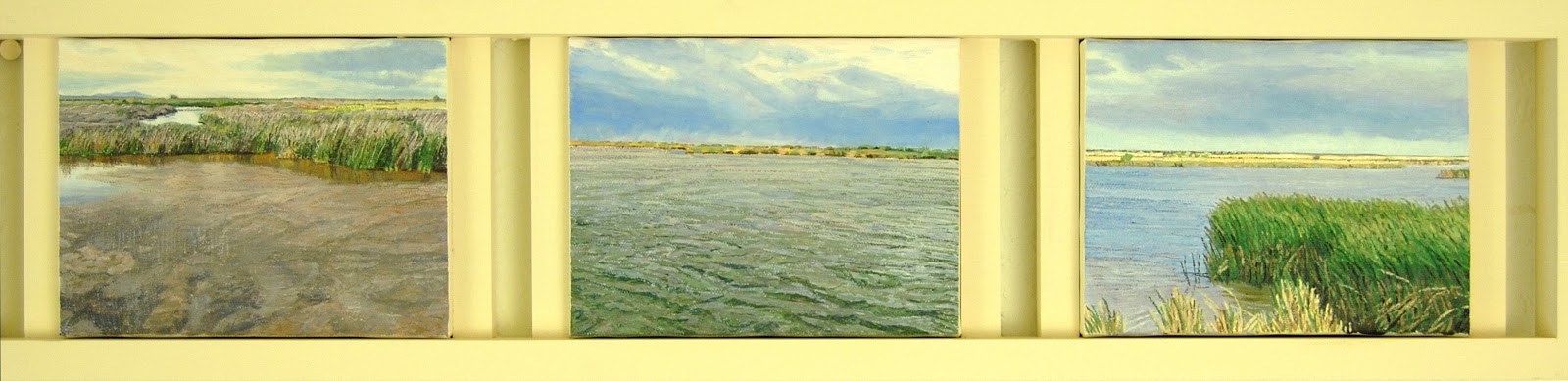
Clear Lake, Utah: Landscape Painting by Lloyd Brown Captures Desert Wetlands


Details: Clear Lake, Millard County, Utah (The Loneliest Road in America)
oil on canvas
7 x 57 1/8 inches


The images for this painting came from a drive my brother Steve and his family and I took to Clear Lake.  Leaving town we hit a squall.  The early summer afternoons were filled with frequent thunderstorms.  It was difficult to tell if the shafts were veils of rain or curtains of dust.  This was new.  Although it was desert to the west for as far as the eye could see, dust squalls were limited to gusty southerly breezes that abruptly switched course to a sandblasting kind of cold just ahead of snow.  Not all snowstorms precipitated dust, but some swept in with a choking grey just ahead of whiteout.

            The current dust comes from fire or a series of fires that burned more than 360,000 acres of trees, shrubbery and grasslands to the southwest of town the summer of 2007.  We were away at a family reunion in northern Utah.  The news was short on information; we couldn’t tell where the fire was burning.  The freeway was closed; we knew that much, but because so many TV reporters are just pretty faces, they didn’t really know where they were.  The largest fire in Utah’s history was but an abstract distraction between commercial breaks.  When we got home, smoke exposed flames burned away on the horizon for several nights.  When the blaze was close to comatose, the roads we thought we knew turned to delicate ash.  Firefighting teams and machinery beat chalky ruts to alkali power.  As we drove through dusty brush, an unspoken dread of getting stuck was mentioned.  A driver never cares to hear those tones of concern turn to scolding satisfaction when a dreaded event happens.  The road improved.  Blackness came into view and silenced what could have been a scorn of superiority.    

            The fire explains the vast shafts of dust and veiled rain.  It is hard to tell which will prevail until the first droplets hit the skin so cold, you recoil.  It’s not like that everywhere.  Rain is not always met with darting alarm.  Pelts are only pelts because the cold makes it so.  Babies are not baptized in ice water for a reason.  I didn’t know that until I left the Basin and Range region of the United States.  A downpour can be like standing in a shower.  Although ducking for cover is common practice, in many places it is just about staying dry.


            As we walked around the lake, clouds were very much a part of the scenery.  Atmospheric conditions of filtered light and rain, and the small scale of the painting obscure the mountainous terrain of the horizons.   It could be almost anywhere.  Water is the thing we see and I am reminded of being out in a boat around Port Aransas.  The difference is mainly scale.  Shallows and reeds, sky high clouds cast in sedimentary decay, mercury colored mud languidly underscores the distillation of a breeze, an unbroken transparency dancing in ripple and wave across the water.  With a little imagination, the scene could be anywhere along the Texas coastline.  The difference is one of confinement.  Mountains surround the lake in a sea of sage.